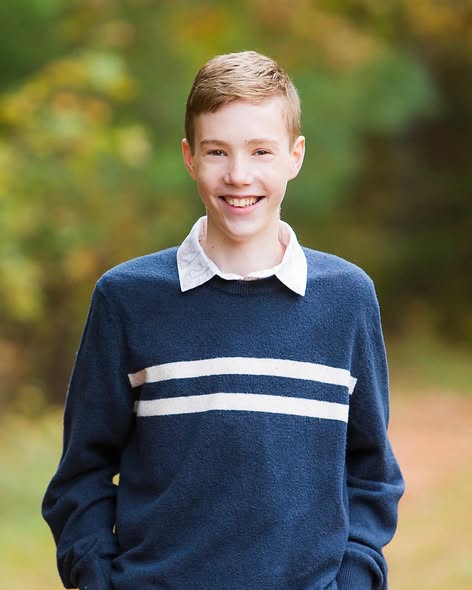
Jonas Faulkner Obituary: Beloved Son of Joe Gibbs Racing Engineer Dies at 16 After Courageous Epilepsy Battle – Racing Community Pays Tribute.
A Life That Shone Brightly, Cut Short Far Too Soon
The roar of engines at racetracks across America will feel a little quieter this season. Jonas Faulkner, a vibrant 16-year-old who lived with unwavering courage in the face of severe epilepsy and complex neurological challenges, has passed away. His death on Easter morning – a day symbolizing resurrection and peace – has plunged his family into profound grief, yet also brought a bittersweet sense of relief that his long, hard-fought journey is finally over.
Jonas was not a household name beyond his community, but within the tight-knit world of NASCAR and especially within the ranks of Joe Gibbs Racing (JGR), he was a cherished figure. His father, a dedicated engineer at the championship-winning team, had for years brought Jonas’s spirit into the garage area. When the news of Jonas’s passing spread, it was met with an outpouring of sorrow and solidarity. In a deeply moving tribute, multiple Joe Gibbs Racing team cars carried special decals bearing Jonas’s name or initials during a recent race weekend – a visible, high-speed memorial that spoke volumes about how deeply the teenager had touched the hearts of mechanics, drivers, and crew members alike.
For those who only knew Jonas through the decals or passing mentions, the image of a smiling, energetic teenager who loved go-karting and video games might seem at odds with the reality of his daily battles. But that was precisely who Jonas was: a young man who refused to let his medical condition steal his joy.
A Childhood Defined by Medical Complexity
From his earliest years, Jonas’s life was marked by hospital visits, seizure management, and the constant uncertainty that comes with severe epilepsy. His form of the condition was not easily controlled by medication; it required round-the-clock vigilance, frequent adjustments to treatment plans, and a home environment adapted to keep him safe. Yet those who knew him best say that Jonas never once asked, “Why me?”
Instead, he developed a resilience that astonished doctors and inspired family friends. He learned to recognize the early signs of an oncoming seizure – a flicker of light, a moment of disorientation – and would calmly signal to his parents or caregivers. When he was younger, he would sometimes emerge from a post-seizure haze with confusion and exhaustion, but within hours, he would be reaching for his favorite Mario Bros controller or asking when he could next visit the go-kart track.
“Jonas had more grit in his little finger than most adults have in their entire bodies,” a close family friend recalled. “He fell down – literally and figuratively – so many times. But he always got back up. And he always had a smile ready for you.”
His neurological and medical obstacles were numerous. Alongside epilepsy, Jonas dealt with developmental delays and other complex health issues that required a team of specialists. School was a challenge; social situations could be overwhelming. But Jonas’s innate warmth and curiosity broke through those barriers time and again. He had a gift for making people feel seen – a quick “Hey, nice to see you!” to a passing nurse, a high-five for a fellow patient in a waiting room, or an enthusiastic breakdown of the latest race he’d watched on TV.
The Racing Connection: More Than Just a Hobby
It is impossible to separate Jonas Faulkner’s story from the world of motorsports. His father’s role as an engineer at Joe Gibbs Racing meant that Jonas grew up surrounded by the smell of fuel, the sight of stripped-down chassis, and the constant hum of innovation. While many children of racing insiders take the lifestyle for granted, Jonas embraced it with a pure, unfiltered passion.
He loved everything about racing: the pre-race tension, the deafening start, the strategic pit stops, and the blur of color as cars screamed past. His bedroom walls were decorated with die-cast models, signed hero cards, and photos of his father at work. When he was well enough, Jonas would accompany his dad to the shop, where he became something of a mascot – a bright-eyed kid who asked brilliant questions and remembered every answer.
But his greatest joy was go-karting. Though his epilepsy meant he could never race competitively or without strict supervision, Jonas found a special kind of freedom behind the wheel of a low-speed go-kart. On good days, his family would take him to a local track where he could drive in controlled sessions. The look of pure, unadulterated happiness on his face as he navigated the turns is a memory his parents hold close to their hearts.
“He would come off the track laughing, breathless, and immediately start talking about how he could take the next corner faster,” his mother once shared in a rare interview with a local news outlet. “For those few minutes, he wasn’t a kid with epilepsy. He was just Jonas. Just a boy who loved to go fast.”
A Friend to All: The ‘Super Jonas’ Legacy
Those who spent time with Jonas often used the same words to describe him: sweet, loving, and unfailingly kind. In an age where teenage social dynamics can be brutal, Jonas operated from a place of genuine goodwill. He didn’t care about popularity or cliques. He cared about connection.
At his school, which had a specialized program for students with medical needs, Jonas was known as a peacemaker. If two classmates were arguing, he would roll over in his wheelchair or walk slowly to their table and say something disarmingly simple: “Hey, let’s just be friends, okay?” More often than not, it worked.
His love for basketball – despite physical limitations – was another outlet for his exuberance. He couldn’t run the court or jump for a rebound, but he could shoot free throws with surprising accuracy. During adaptive physical education sessions, he would cheer louder for his peers’ successes than for his own. And when he played Mario Bros or other video games, his competitive side emerged with playful trash talk that left everyone laughing.
One of his favorite routines was “game night” with his parents. They would queue up old racing films, cook his preferred snack (buttered popcorn with a ridiculous amount of salt), and talk for hours about anything and everything – racing strategies, the plot of the latest game he’d beaten, or what he wanted to do “when I get bigger.” Those nights, his family now says, were sacred.
The Easter Morning Goodbye
Jonas Faulkner passed away on Easter morning. For his grieving family, the timing carries a poignant, almost spiritual weight. Easter, after all, is a story of suffering transformed into peace – of a difficult journey ending in rest. After 16 years of seizures, hospital stays, medications, and setbacks, Jonas’s long journey is over.
The exact circumstances surrounding his death have not been publicly detailed by the family, who have asked for privacy during this devastating time. However, close sources indicate that Jonas died peacefully, likely due to complications related to his seizure disorder – a sudden, severe episode from which his body could not recover. There was no accident, no negligence; simply the cruel reality of life with intractable epilepsy.
His parents were by his side. In his final moments, they held his hands and told him how much they loved him, how proud they were, and that it was okay to let go. The boy who had fought so hard for so long finally allowed himself to rest.
An Outpouring of Grief from the Racing World
News of Jonas’s death spread quickly through the Joe Gibbs Racing family. Team owner Joe Gibbs, a Pro Football Hall of Fame coach turned NASCAR titan, issued a personal statement: “The entire JGR organization is heartbroken. Jonas was part of our family – not because of a title or a job, but because of his spirit. He reminded us what really matters. We are praying for his parents and everyone who loved him.”
Drivers, past and present, took to social media. One posted a photo of the decal that had been placed on his car, writing simply, “For Jonas. Rest easy, little man.” Another shared a memory of meeting Jonas at the shop: “He asked me more technical questions about the car than most reporters do. Sharp kid. Kind kid. Gone too soon.”
The tribute of carrying decals on team cars was not a one-off gesture. The Faulkner family has been told that multiple JGR cars will continue to display a small memorial mark for the remainder of the season – a silent, high-speed tribute that will roll past hundreds of thousands of fans at tracks from Daytona to Phoenix.
Remembering ‘Super Jonas’
Among his friends and extended family, Jonas had earned the nickname “Super Jonas” – partly as a playful nod to his love of superheroes, but mostly because of the extraordinary strength he displayed every single day. It was not a nickname he asked for, but one he wore with shy pride.
In the days since his passing, those who knew him have been sharing stories that paint a picture of a boy who was, in every sense, a light. There was the time he insisted on sharing his birthday cake with the entire pediatric neurology ward. The time he drew a thank-you card for the paramedics who had been called to his house after a seizure. The time he noticed a new student sitting alone at lunch and spent the entire period telling bad jokes until the other kid smiled.
“Jonas didn’t just exist in the world,” his father said in a brief, tearful statement released through the team. “He improved it. Every room he walked into got brighter. Every person he talked to felt valued. We are shattered, but we are also so, so grateful that we got to be his parents. He was a blessing – every single day for 16 years.”
A Community’s Loss, A Legacy of Kindness
The death of a child is an unfathomable tragedy. When that child faced as much as Jonas did, yet still radiated joy, the loss feels even more unjust. But those who loved Jonas are determined that his legacy will not be one of sorrow alone. They want him to be remembered for his courage, his friendship, and his ability to find happiness in the simplest moments.
Plans are underway for a memorial service that will celebrate his life rather than mourn his death exclusively. The family has requested that, in lieu of flowers, donations be made to epilepsy research foundations or to programs that provide adaptive go-karting experiences for children with disabilities – two causes that were deeply personal to Jonas.
In the end, Jonas Faulkner’s story is not just about a teenager who died too young. It is about a boy who lived every single day with purpose, who loved without reservation, and who showed everyone around him what real strength looks like. He was a beloved son, a true friend to all, and for those lucky enough to have known him, he will always, always be Super Jonas.
The checkered flag has fallen on his race, but his memory will circle the track forever.
Leave a Reply